

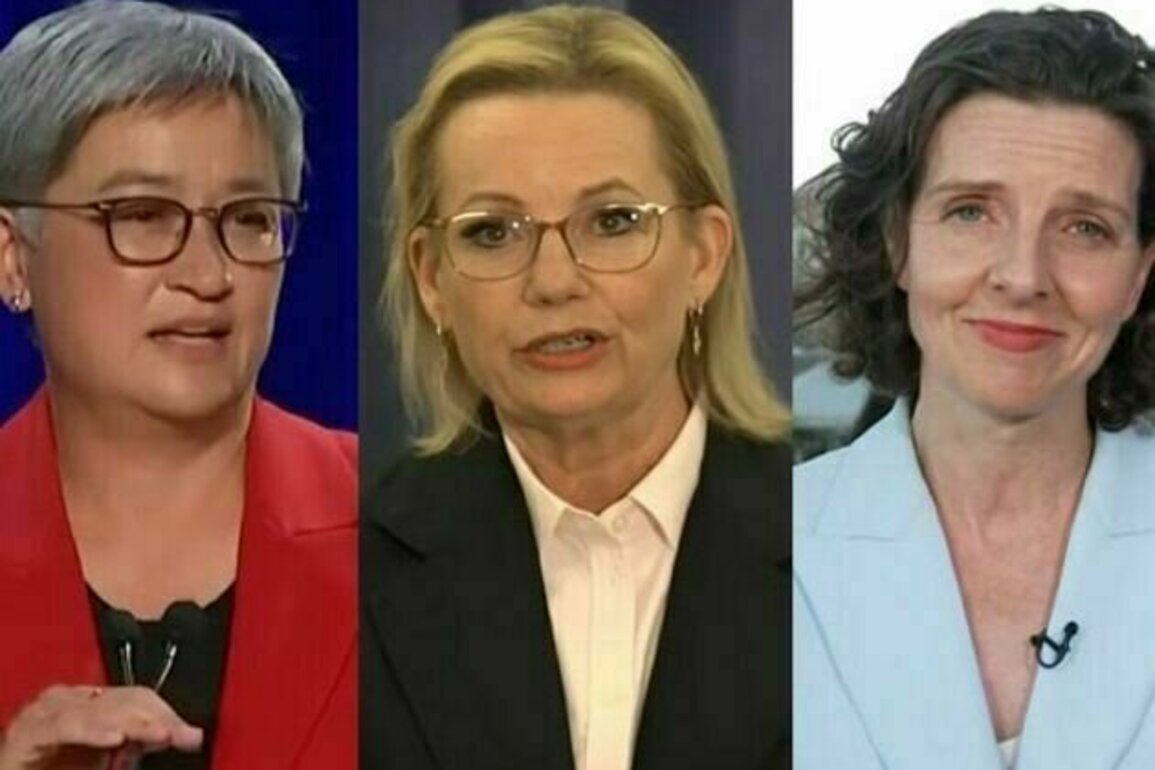
There has been much robustness in politics boosted by the rapid growth of female participation, demonstrated in the last parliament in the Senate, where women dominate the front benches.
DrLee Duffieldhas been observing the fray and making an assessment in the traditional way of politics, by counting the numbers.
SHOUTING MATCHES broadcast from the Senate, nothing frail there, easily outdo the low rumblings of its days as an old boys club for selected party apparatchiks, retired professionals, farmers on furlough, superannuated union leaders.
Daunting encounters
Today, it can be daunting.
The Government Leader, SenatorPenny Wong, being very stern, now and then doing her block; the Senate Opposition Leader, SenatorMichaelia Cash, getting up a farmyard rebel yell; joining in from the cross benches, Greens SenatorSarah Hanson-Young, doing indignation and toxic glares; Independent SenatorJacqui Lambie, performing famous, exponential raves; occasionally the unmistakable crabby tones of SenatorPauline Hansonof One Nation.
While the passion and entertainment value are strong, the quality is likewise, as indicated by the eagerness of parties (with some holding back on the right-wing side) to have more women in parliament, more in leading roles.
Leying down the new order with Sussan: A Liberal Party fictional taleA woman has been voted leader of the Liberal Party, but will Sussan Ley listento voters and "modernise" the party, and is her appointment a breakthrough for women?
More women
The Labor Party has been the leader since taking up various quotas or affirmative action schemes to get it started in the 1990s and this year, for the first time, women will make upmore than halfthe Federal Labor caucus (54% in the Representatives, 63% Senate).
The Cabinet has12 women ministers and 11 men, a figureproudly quotedby Prime MinisterAnthony Albanese. The gentlemen catch up in the outer ministry, assistant ministers and special envoys, with 27 men and 19 women in the full leadership team.
Eight of the 12 Greens members are women and eight of the 11 Independent MHRs, the men being two dissident Nationals and the Tasmanian MemberAndrew Wilkie.
The Liberals, having joined Laborten years agoin declaring for parity in numbers, have been lagging behind. Not just because, after two election defeats, it has been hard to win seats. One study claimed that in 2025, conservative resistance to any compensatory rule changes had women candidatesonly in 32% of seats, overwhelmingly in risky marginals. That against the Labor Government, at 56%; in one example, augmenting its female quota by getting five women into the seven new positions it wonthis year in Queensland. (Overall,45% of 2025 candidateswere women.)
Fewer women less performance?
Complacency in discouraging over half the population can defray quality. Liberal LeaderSussan Leyprovidedan 11-11 gender balancein a shadow ministry list, plus four male assistants. And the party cosmeticises its weak situation by clustering women members in front of the cameras in the House.
Not enough and the 50-50 arrangement would itself be short-lived. Giving everybody in a small pool a top job cannot guarantee performance. Some came out badly in interviews under the pressure of the recent election campaign.
WitnessJane Hume, the hapless public service spokesperson sent out to reverse the policy against working from home; a stridently partisan interviewee even in fair weather, who ended up refusing questions by uttering a single repetitive line, even breaking off intoslogans: It wont be easy under Albanese, she said. (As it happened, Senator Hume was passed over for the revised Shadow Cabinet announced on 28 May.)
It is similar with the National Party, trying to look a little feminised, but still naming 14 men against six women in its own list of spokespersons. Party LeaderDavid Littleproudand DeputyKevin Hoganrarely face cameras unless accompanied byBridget McKenzie, presumably as Senate Leader, to add female presence.
Albaneses team making progress on Whitlams promise to womenThe latest global report on the gender gap shows Australia reversing its recent sharp downward slide, reportsAlan Austin.
Perhaps not a convincing choice. In 2025, Senator McKenzie, an Annie-get-your-gun character from the country (once the centre of thesports rortsaffair, including controversy over agovernment grantto her shooting club), and another strident and most-partisan arguer, appears to have taken up cross-dressing sporting heavy barrister striped suits, curious boots and an old-school-style neck-tie.
When the Liberals and Nationals had their reconciliation on 28 May, the formation of a joint Coalition Shadow Ministry, all smiles stopped altogether on having a gender balance. There are 15 men and eight women in the Shadow Cabinet, more male-dominated than under the leadership ofPeter Dutton. Counting in lesser jobs, they have 19 men and 11 women in the Shadow Ministry.
A paucity of policy and incapacity to argue a case on the Liberal side, which was shown up in 2025, has had Labor TreasurerJim Chalmerstalking about a lack of intellectual horsepower among his opponents; unsurprising, if they are only putting up half a team.
Where are the Liberal women? Look at the Teals
Maybe the Party, as it now stands, does not have that many players who are, by background, personality and preparation, individually interested or competent with policies and ideas. Which might be to say, not good enough to run the country anyway.
If anybody wants to know where the Liberal women have gone and how much quality of thinking and argument went with them, just look at the so-called Teals. This is the core group of five women Independent members called Teals, and two others fairly closely aligned in outlook and policy. They have to be labelled centrists, being strong on the environment and sandwiched between the main parties.
None would consent to be hacks in some blokes party wracked by opportunism and spite, harbouring climate deniers, identity nationalists and the like, but could have found a place in a moderate centre-right formation seriously concerned with statecraft.
Not all have the weight ofAllegra Spender, Member for what was the long-time Liberal fiefdom of Wentworth, in Sydneys Eastern suburbs, but it is an indicative case. With a long Liberal pedigree and thorough professional preparation and experience in economics and business, Ms Spender has been making strong interventions, carrying influence across different fields as taxation reform, climate change and dealing with antisemitism. She should be a minister; too bad for the Liberals not to be able to accommodate women of that ability.
Gender equality ten years on from Gillard's Misogyny SpeechThe Misogyny Speech may be trending but what has really changed ten years on?
Numbers in the Parliament
A footnote on the new Parliament.
TheElection on 3 Maysaw a general swing of 3.2% to the Government, giving Labor 34.6% of the primary vote; Liberal 31.8%; Greens 12.2%; One Nation 6.4%; Trumpet 1.9%; and all others 13.1%. Local swings occurred up to 10% or slightly more, even in a few cases against the general trend, going to Liberals, but the overall impact was the big sweep for Labor. It won two-party preferred by 55.3% to 44.7%, netting 94 seats out of 150 in the House of Representatives and became the only government since 1966 to lose none of its own seats at the polls.
So, barring pestilence, disaster, war or world recession, Labor has a chance to do all it would want over 3-6 years.
With only three of the Independents on the Right wing (Dai Le,Andrew GeeandBob Katter), the mentality of the House of Representatives has a disposition towards reform, or at very least intelligent and reasoned problem-solving: 103 centre and centre-left, 46 centre-right.
It can be similar in the Senate, where any reforms have to be cleared, and the 11 Greens senators have the balance of power. Greens sometimes shelve the environment and turn red, and can show remarkable hatred for Labor, a shadow of the old Communist Party resentment of Labor taking up the space on the Left wing. But reading it as Labor, plus an ecologist party and some reform-minded Independents, the new Senate is another house that should be friendly to change.
That might well be a reflection of Australian society in 2025; if the Liberals could resist the temptation to make themselves be outcasts and rednecks, it could be a place where reason will prevail across the board.
Amongst DrLee Duffields vast journalistic experience, he has served as ABC's European correspondent. He is also an esteemed academic and member of the editorial advisory board of Pacific Journalism Review and elected member of the University of Queensland Senate.