


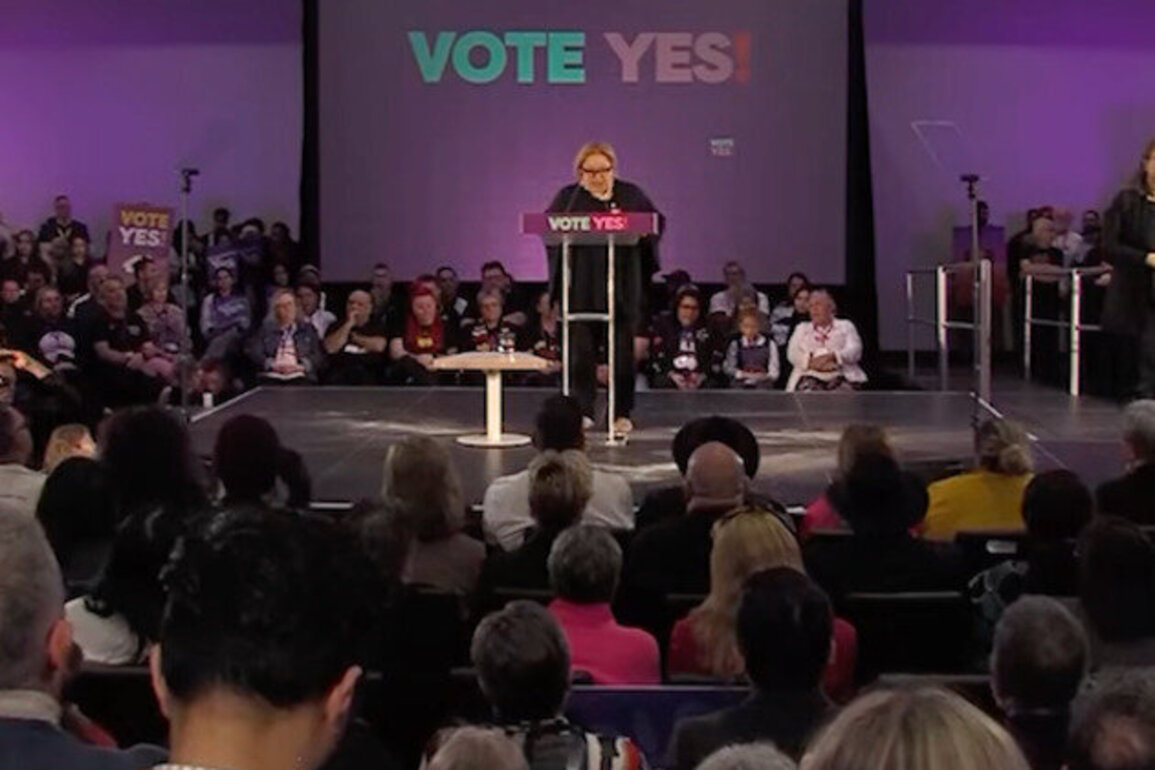
The failed Voice Referendum was a fatal demonstration of the adversarial nature of our two-party electoral system, writesDrKlaas Woldring.
THE PRIME MINISTERwas clearly very disappointed about the outcome of the Voice Referendum. However, this should really be an impetus for major system reforms. Why did this Referendum really fail?
The unsuccessful Voice Referendum clearly showed the negativity of the electoral (two-party) system as well as the serious lack of knowledge of Australias political system and its Constitution. The outcome was completely different from the outcome of the 1967 Referendum. How could this be? Here is a quote to illustrate the difference:
Awed Albo abandons republic (and Australia's dignity) in haste to embrace King CharlesAlbo's recent meeting with Charles Windsor and aviddeclaration that Australia would not become a fully independent nation had interesting echoes to the past.
The recent Vote NO drama was more than half a century later. Sure, this would have been a logical step further to support the Indigenous people but the Opposition, arguing formally against the Uluru proposal, was a major step backwards and, particularly, a fatal demonstration of the adversarial nature of the two-party electoral system, based on Single Member Districts.
Therefore, a series of election system reforms should start as soon as possible. The existing Constitution even very clearly regards this particular power as the prerogative of the Federal and State Parliaments. So why not get on with that, Prime Minister? Could it be the system conservatism and/or the self-interest of the ALP? If so, that is surely not helpful for the country at all and, therefore, false self-interest.
Proportional representation is used by 90 countries in the world, particularly successfully in the Nordic countries. Contrary to what supporters of the two-party system claim, the Single Member District system is not only an undemocratic system which grossly favours the major parties, but it also stimulates adversity. The most recent outcome of the federal election of 2025 is a prime example of the unfairness and polarising nature of the system. Yes, on that occasion, it benefited the ALP which scored a little over the vote and nearly two-thirds of the seats.
The sitting arrangements in the Parliament further encourage adversarial debates and culture. The Joint Standing Committee on Electoral Matters, always dominated by the major parties, has failed to come up with the most important reform and has proved to be not a reformist committee. A great further advantage of this electoral system reform would be that it does not require a constitutional amendment, a major plus. This reform would greatly enhance the chance of all other necessary reforms as it would remove the adversarial nature of the existing political system.
A second major reform would be the Constitution itself, which is ancient, complex, and largely based on the colonial relationship with the UK, a situation now far behind us. A new Constitution should create a multi-cultural Republic that can easily be amended, and which leaves room for the reform or ending of the federation. Federation made perfect sense in 1900, but is often a hindrance now for effective national legislation-making, while much improved communication facilitates central government decision-making.
Included in a Republican Constitution would be the essence of the recent VOICE proposals, which were knocked back largely as a result of the typically adversarial campaign once the other major party decided that it should officially oppose what was/is essentially, a sound proposal.
How the media failed Australia in the Referendum 'campaign'The mainstream media's performance during the Voice Referendum campaign was an abject failure.
Could this be left to the conservative coalition parties? No Sir, this is the ALPs job, it really is your job!
Carpe diem, Prime Minister.
Changing the electoral system could be done even during this current parliamentary session and could only be welcomed by voters, even though the ALP may have to form an electoral coalition with the Greens and/or some Independents. Most PR Governments are coalitions, of course. The major change to a Republic could be prepared for the next parliamentary session. My own view is that the ALP would actually benefit from such measures, but the main thing is that democracy in Australia would be strengthened, including for more conservative parties.
Lack of knowledge of the Constitution is due to very inadequate civics education. There was an important Federal Government Inquiry in 2003/4 into the reasons of the failure of the 1999 Republic Referendum. Overwhelmingly, lack of civics education and inadequate university education were seen as the principal reasons. Young people especially but also new Australians, do not know enough about the Constitution and the electoral system, and even less about alternatives to the existing governance systems. Actually, in spite of the findings of that major inquiry, this situation has not improved, possibly even worsened. So yes, how can this be remedied?
The ABC could do a lot of good here but, thus far, hasnt done enough either; the commercial broadcasters even less. Social media seems not at all concerned with this situation. It is therefore primarily up to the Albanese Government to enlighten the people through ABC educational programs about the political organisation of the country. This could start with programs about the findings of that Committee (2003/4) and what has actually been done about their recommendations.
It would also be helpful for Australians to see how other countries organise their governance systems: the electoral system in non-English-speaking countries, the reality that Prime Ministers and other Ministers are often not elected but appointed by governing parties from the entire society, oftennot members of the Parliament. The knowledge about democraticnon-English political systems in Australia is woeful.
There is plenty of material and examples to be discussed on radio, TV and social media. There are also lots of relevant books that should be in Libraries but are often not there. There is a lot more to know than what goes on in the Westminster system, itself in serious trouble frankly, and also about the U.S. system that has now produced a president of very questionable quality. The commercialisation of universities since around the mid-1990s has done a lotof damage to the study of governance systems. But in the short term, the Government itself could surely publish purely educational material.
DrKlaas Woldringis a former associate professor atSouthern Cross Universityand former convenor of ABC Friends (Central Coast).
Related Articles
- ALPs lucky win masks a rotten electoral system