

The arrival of Britains HMS Anson in Western Australia highlights the historic ties, industrial risks and strategic stakes behind Australias $300 billion AUKUS submarine pact, writesVince Hooper.
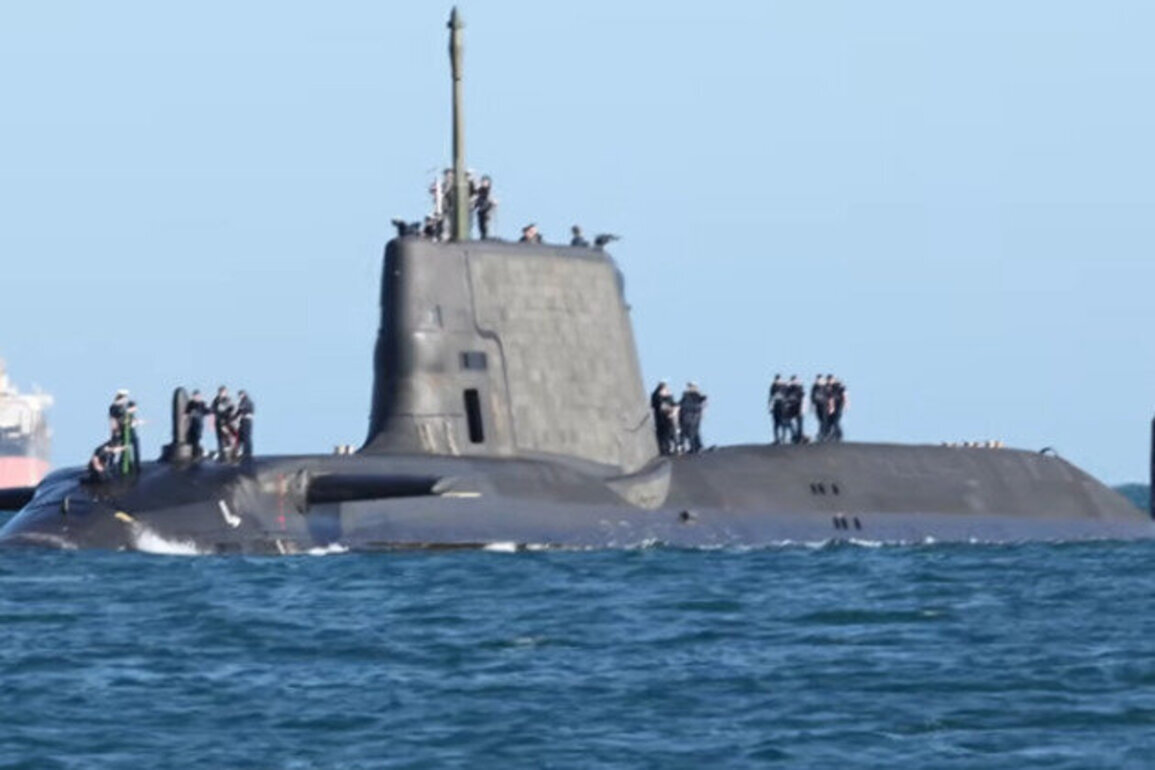
WHENHMS ANSONarrived off Garden Island, Western Australia, on 22 February, an Indigenous elder named Barry Winmar conducted a Welcome to Country for a nuclear-powered attack submarine.
It was a moment that compressed several centuries of history into a single image: the oldest continuous culture on Earth greeting the newest expression of an alliance that traces its origins to a Devon harbour in 1768. CommanderAaron Williams, Ansons commanding officer,toldthe assembled dignitaries that his crew had travelled more than 8,000 nautical miles unsupported through Gibraltar, the Mediterranean and the Suez Canal to showcase what HMS Anson has to offer.
What she has to offer, in blunt terms, is Tomahawk cruise missiles, Spearfish torpedoes, and 250 years of shared maritime purpose between Plymouth and Sydney. The question Australians should be asking is whether any of that will be enough.
The historical thread is not mere sentiment. On 26 August 1768, LieutenantJames Cookguided HM Bark Endeavour out of Plymouth Harbour carrying 94 souls and sealed Admiralty orders. He charted Australias eastern coastline and recommended Botany Bay for settlement.
AUKUS and the submarine illusion: Australias $368 billion surrenderAs Washington debates whether it can spare the submarines, Canberra continues to pay for vessels it may never fully control.
Less than two decades later, the First Fleet sailed from Portsmouth two of its transports, the Friendship and Charlotte, having assembled from Plymouth, its marine garrison drawn from the Plymouth and Portsmouth divisions and founded the penal colony at Sydney Cove on 26 January 1788.
Cooks second and third voyages also departed Plymouth in 1772 and 1776. No harbour on Earth has launched more voyages of consequence: the Mayflower,Drakes circumnavigation and the convict transports that seeded modern Australia. Sydney grew from the anchorage Cook charted and the settlementArthur Phillipbuilt. The two cities are, in the most literal sense, parent and child of British maritime endeavour.
That genealogy matters now becauseAUKUSthe trilateral submarine pact between Australia, the United Kingdom and the United States announced in September 2021 is not a diplomatic abstraction. It is an industrial bet of staggering proportions, and Plymouths Devonport Dockyard sits at its mechanical heart.
Devonport is the Royal Navys sole facility for nuclear submarine repair and refuelling. Every Astute-class boat passes through its dry docks. The dockyard has been operational since 1691, whenEdmund Dummerbuilt the first stepped stone dry dock in Europe on the Hamoaze. It is the largest naval base in Western Europe. It generates roughly ten per cent of Plymouths income.
And it is now the chokepoint on which the credibility of a 300-billion-Australian-dollar alliance depends.
Here is the uncomfortable arithmetic. TheRoyal Navy Submarine Serviceis celebrating its 125th anniversary this year. For a portion of that anniversary year, not a single one of its attack submarines was at sea. As of late 2025,HMS Ambushhad been stripped of parts to keep her sisters running a multi-billion-pound warship reduced to a donor vehicle, like a cannibalised Holden in a country wrecking yard.
HMS Audacioussat in a Devonport dry dock for more than 16 months after a record deployment, waiting for refit space and resources that did not materialise on schedule. HMS Anson, the boat now being fussed over at HMAS Stirling by a hundred personnel from three nations, was effectively the only operational Astute-class submarine the Royal Navy possessed.
Sending her to Australia was a calculated gamble: trade short-term availability in the North Atlantic, where Russian submarine activity is intensifying, for long-term alliance credibility in the Pacific. It is the kind of trade-off that would have been familiar to the Admiralty lords who dispatched Cook to the unknown southern ocean while simultaneously fighting for supremacy in European waters. Except that Cooks Endeavour cost the Crown 2,840 (AU$5,398). HMS Anson cost approximately 1.6 billion (AU$3 billion).
Weapons still being funded over survivalHumanity is in a trillion-dollar arms race, struggling to choose survival over self-destruction.
AUKUS demands that we take this gamble seriously because the stakes for Australia are existential in a way they are not for Britain. The SSN-AUKUS class a next-generation nuclear-powered attack submarine based on the United Kingdoms design and incorporating American propulsion and combat systems will be operated by both the Royal Navy and the Royal Australian Navy.
Britain plans to build up to 12 of them. Australia will construct at least five at a new yard in Osborne, South Australia, for which Canberra committed a$3.9 billion down paymentin February. Australia has also pledged $4.5billion over a decade to expand Britains nuclear submarine industrial capacity and last week announced $310 million for long-lead reactor components from Rolls-Royce in Derby.
This is not an arms purchase. It is an industrial marriage, and like all marriages, it relies on trust that neither party can fully verify in advance.
The trust is being built, right now, in the most prosaic ways imaginable. At HMAS Stirling, Australian engineers are learning to work on Ansons hydraulic systems. They are running simulated emergency exercises and conducting in-water engineering alongside Royal Navy specialists and American technicians fromPearl Harbour Naval Shipyard.
Five local Perth businesses have manufactured components to be installed on the submarine a small detail, but precisely the kind of supply-chain integration that turns a political agreement into an industrial reality. Two Royal Australian Navy officers are embedded aboard Anson. More than 50 Australians are stationed within the UKsDefence Nuclear Enterprise.
The Royal Navy has provided nuclear safety training to over 950Australian Submarine Agencypersonnel. This is the dull, essential plumbing of an alliance: people learning one anothers procedures, safety protocols and paperwork. It is not glamorous. It is what makes the difference between a partnership that works and one that doesnt.
Plymouths role extends beyond maintaining the existing fleet. Devonport is where the Royal Navys first uncrewed submarine,Excalibur, was unveiled in May 2025 underAUKUS Pillar IIthe advanced capabilities arm of the pact that covers artificial intelligence, quantum computing, autonomous systems and hypersonics.
When America raises the bill, Australia pays the priceAs Washington demands unprecedented military spending from its allies, Australia faces a stark choice between strategic loyalty and the preservation of its social and economic foundations.
DuringExercise Talisman Sabrelast August, Excalibur was controlled from a remote operations centre in Australia, more than 16,000 kilometres from its Plymouth home port the first time Britain and Australia had demonstrated autonomous undersea interoperability as a single fighting force. It was a 21st-century echo of Cooks transit of Venus observations from Tahiti: practical science in the service of national power, funded by government, executed at the far end of the Earth.
TheSubmarine Rotational Force-West, scheduled to begin operating from HMAS Stirling in 2027, will see British and American nuclear submarines rotating through Western Australia on a semi-permanent basis up to one British and four American boats, explicitly framed as rotation rather than permanent basing. For the submariners, it offers an overseas posting with operational purpose and, one suspects, rather better weather than Faslane.
For Australia, it provides something no amount of classroom training can replicate: the institutional muscle memory of maintaining nuclear reactors, managing radioactive waste and keeping enormously complex machines safe beneath the ocean. For both countries, it represents the deepest defence integration since the combined operations of the Second World War.
Australian readers should understand what is at risk if this falters. The ambitious target of a new AUKUS submarine every 18 months from Barrow-in-Furness demands sustained political commitment across electoral cycles in three countries. Devonports dry docks are already a bottleneck; one Astute boat sat idle for months waiting for dock space in Plymouth. And South Australias Osborne yard, which will become the only facility in the southern hemisphere capable of constructing nuclear submarines, must replicate Barrows production methodology identically an extraordinary industrial undertaking for a country that closed its last car factory less than a decade ago.
The scale, at least, is not in doubt. The Osborne fabrication hall alone will stretch 420 metres two and a half times the length of Adelaide Oval and the yard will consume 126,000 tonnes of structural steel, the equivalent of seventeen Eiffel Towers.
South Australian PremierPeter Malinauskas, who has staked South Australias economic future on the programme, put it withcharacteristic bluntness: the scale of what is coming is difficult for most people to comprehend. He is not wrong. Seventy Australian companies are already qualifying for AUKUS supply-chain work.
Pacific Marine Batteries, based down the road from Osborne, already supplies batteries for the British Astute-class submarines and has been contracted for SSN-AUKUS not just for Australias boats, but for Britains. That is the kind of two-way industrial integration that turns a defence pact into something much harder to unpick.
We should never have agreed to AUKUSAustralia is paying for America's submarines, striking a deal with a President we still have to fact-check.
Critics (and there are many) argue that Australia is paying an enormous premium for a capability it will not possess independently until the 2040s, while simultaneously making itself dependent on British and American industrial competence that is far from guaranteed. They have a point. But the counterargument is equally blunt: no other pathway gives Australia a credible undersea deterrent in an Indo-Pacific where the submarine fleets of potential adversaries are growing faster than those of the democracies.
Diesel-electric boats, whatever their merits, cannot match the endurance, stealth or range of nuclear-powered submarines. If you accept the strategic premise and I do then AUKUS is not a luxury but a necessity, and Plymouths dockyard workers are not a quaint historical footnote but a critical dependency.
There is, finally, a pleasing irony in all of this. When the British First Fleet arrived at Botany Bay in January 1788, it encountered the French expedition ofLa Prouse, which had departed Brest in 1785 on orders fromLouis XVI, inspired by Cooks voyages, arriving within days.
The original contest for the southern ocean was Anglo-French. Todays AUKUS was born, in part, from the wreckage of the cancelled French submarine contract with Australia a $90 billion deal scrapped in favour of the trilateral pact. Plus a change.
Plymouth and Sydney have been connected by the sea for more than a quarter of a millennium. Cooks departure in 1768, Phillips settlement in 1788, the convict ships, the troopships, the trade routes, the ANZAC departures all of these form the deep history of a relationship that has adapted repeatedly to new circumstances and new threats. AUKUS is the latest adaptation, and by far the most ambitious.
When Deputy MayorBarry Winmarwelcomed HMS Anson to Western Australian waters last month, he was welcoming not just a submarine but a proposition: that two countries separated by 10,000 miles of ocean can build, maintain and operate the most complex machines ever devised, together, for decades to come.
The connection from Plymouth to Sydney endures. It has simply gone nuclear. Whether the industrial base can match the political ambition will be the test of our generation.
Vince Hooperis a proud Australian/British citizen and professor of finance and discipline head at SP Jain School of Global Management with campuses in London, Dubai, Mumbai, Singapore and Sydney.
Related Articles
- Mark Carneys warning: Albanese is choosing weakness for Australia
- AUKUS and the submarine illusion: Australias $368 billion surrender
- When America raises the bill, Australia pays the price
- Invisible no more: How drone warfare exposes AUKUS strategic blind spot
- We should never have agreed to AUKUS