

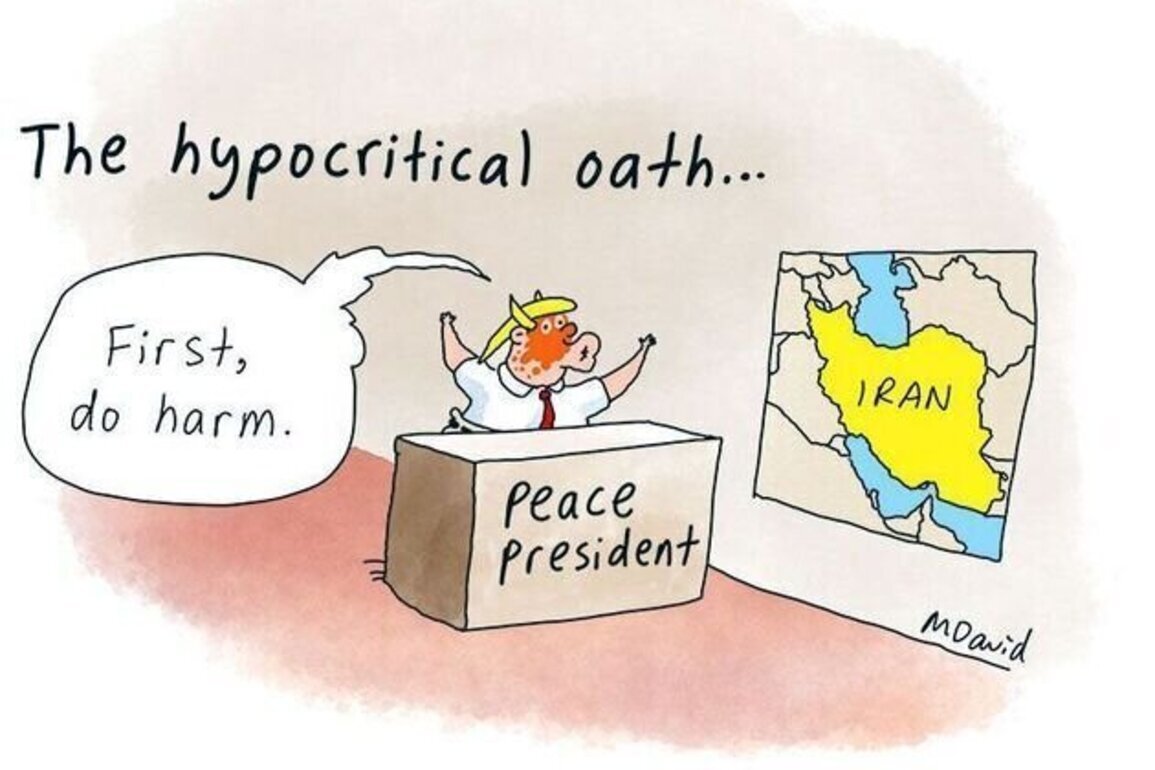
Australia is entangled in a war it never voted for, with silence masking how deeply its alliances and infrastructure make it complicit, writesHassan El Biali.
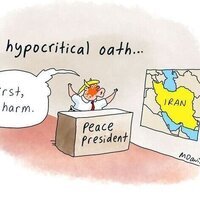
WHILE THE UNITED STATES bombs Iran, Australia says nothing because saying nothing is the plan. A look at howAUKUSandPine Gaphave turned Australian soil into a de facto participant in a war no Australian ever voted for.
I was watching footage from the first week ofOperation Epic Furythe port infrastructure in flames, the cable news generals with their laser pointers when a Canberra statement flashed across the ticker. Australia noted the strikes. Australia stood by its allies. Nothing further to add.
Nothing further to add. While a country of 90 million people was being bombed.
That silence isn't embarrassment. It's policy. And Australians who were never consulted, never given a parliamentary vote, deserve to understand what their government is doing in their name.
AUKUS ties nuclear anchor around Australia's neckThree years ago, Anthony Albanese signed Australia up to quite possibly the worst deal in our history.
AUKUS was never just about submarines
When AUKUS launched in 2021, it was sold as strategic modernisation.Nuclear-powered submarines. Technology sharing. A hedge against an uncertain Indo-Pacific. What it was never honestly described as was a structural commitment to fightAmerica's wars.
U.S. Marines haverotated through Darwinsince 2012. American B-52s operate out ofRAAF Tindal. Pine Gap the joint facility near Alice Springs contributes to missile tracking and, according to independent analysts, to U.S. targeting operations across the Middle East. When bombs fall on Iran, Australian infrastructure is almost certainly part of the operational picture.
Nobody in Canberra has confirmed this. Nobody has denied it either.
The vote that never happened
Here is the part that should make every Australian angry: there was no vote.
Not in parliament. Not in a referendum. The decision to embed Australia so deeply in U.S. military infrastructure, to the point where disentanglement becomes impossible in a crisis, was made quietly, across governments of both parties, withalmost no democratic scrutiny.
TheAlbanese Government's responseto Operation Epic Fury has been a masterclass in strategic ambiguity. Ministers expressed concern about stability while reaffirming the alliance. They called for diplomatic solutions while declining to criticise the military campaign triggering the crisis.
Compare that toGermany and Franceboth NATO allies who said publicly that unilateral strikes without UN authorisation were a mistake. Australia, with no treaty obligation to support this war, couldn't manage even that.
The cost of loyalty: Australias silence in Americas warAustralias continued loyalty to the U.S. alliance is framed as strategic necessity, but increasingly looks like silence in the face of war and declining democratic values.
Pine Gap and the question no one wants to answer
Pine Gap is one of the most important American intelligence assets on Earth. It intercepts signals across Asia, the Middle East and the Indian Ocean. Former intelligence officials including Australians have said it contributes to the targeting data used in U.S. drone and strike operations.
Whether Australian personnel bear legal responsibility for what those operations produce is a live question ininternational humanitarian law. Canberra has never answered it. TheMinab school strike in March 2026, which killed at least 175 students, makes that silence harder to defend.
Even theTrump Administrationinitially tried to deny that the strike was carried out with American weapons.
What an independent foreign policy would look like
None of this is an argument for scrapping the U.S. alliance. It's an argument for Australia having a view.New Zealandhas managed it. Canada has pushed back on specific U.S. operations before, loudly, without the alliance collapsing.
A genuinely independent Australia would have demanded a UN Security Council referral before the strikes. It would have insisted that Australian territory cannot be used in operations that breach international humanitarian law. It would have put the question to parliament.
None of that happened. None of it is being seriously proposed.
Australias $300b AUKUS bet hinges on Britains submarine capacityThe arrival of Britains HMS Anson in Western Australia highlights the historic ties, industrial risks and strategic stakes behind Australias $300 billion AUKUS submarine pact.
The non-proliferation own goal
Australia presents itself as a champion ofnuclear non-proliferation. We signed the NPT. We support inspection regimes. And then we provide infrastructure, however deniable, to a military campaign that has done more to incentivise nuclear weapons development in the Middle East than anything since Iraq.
Every serious analyst will tell you: a country that has just been bombed without a nuclear deterrent willdraw the obvious lessonabout what a nuclear deterrent is for. The contradiction is staggering. And it's barely being spoken.
Canberra owes us an answer
I don't know exactly what Australian systems contributed to Operation Epic Fury. I don't know whether Pine Gap data fed the targeting chain that hit that school in Minab. I don't know whether any Australian official raised objections and was overruled.
Neither do you. That's the problem.
In a democracy, when your country participates in a war, even indirectly, even through infrastructure, even through silence, the public has a right to know. Not a declassified summary in three years. Now.
The people funding these facilities deserve to know what they're paying for.
Hassan Elbialiis a political analyst and commentator specialising in international relations, geopolitical affairs, and the intersection of law and power.
Related Articles
- AUKUS ties nuclear anchor around Australia's neck
- Australias $300b AUKUS bet hinges on Britains submarine capacity
- Mark Carneys warning: Albanese is choosing weakness for Australia
- AUKUS and the submarine illusion: Australias $368 billion surrender
- When America raises the bill, Australia pays the price