

The 9th of May is a beautiful time of the year, with breezy, high-skied blue days around Australia. It is also a date that resonates in Australian civic history, writes history editor, DrGlenn Davies.
ON 9 MAY 2026, the Australian Federal Parliament will have its quasquicentennial anniversary. One hundred and twenty-five years ago, the Australian Federal Parliament met at theRoyal Exhibition Buildingin Melbourne for the first time.
When Australians finally decide on establishing our own independent nation, the obvious day of the year to inaugurate the Republic (new Commonwealth) of Australia is 9 May.
On 1 January 1901, 60,000 people gathered inCentennial Park, Sydney, to witness the proclamation of theFederal Constitution. One hundred and twenty-five years later,Prime Minster Anthony Albanese wrote inThe Sydney Morning Heraldof the importance of the 125th anniversary of the federation of Australia and the impact Australias democratic processes have had beyond our shores, such as the secret ballot, womens right to vote, compulsory voting and a fair days wage for a fair days work.
Changing Australia's flag the first step toward independenceAustralias flag remains a colonial relic and changing it could be the first step toward true independence.
Albanese wrote:
He finished his reflection with:
On 1 January 1901, after years of debate, the various colonies in Australia joined together to form a Federation. While the new Constitution of Australia called for a new capital to be constructed, away from the major cities, until that time Melbourne would act as the seat of government of the new nation.
Elections were held for the first Parliament of Australia and, on 9 May 1901, the newly minted Federal Parliamentwas sworn inat the Royal Exhibition Building in the Carlton Gardens in front of 12,000 people.
(Image viaNational Archives Australia)
The first sitting was held the following day in theVictorian Parliament Houseon Spring Street, Melbourne.
Group photograph of all Federal Labour Party MPs elected at the inaugural 1901 election (Image via Wikimedia Commons)
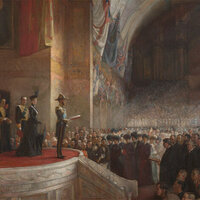
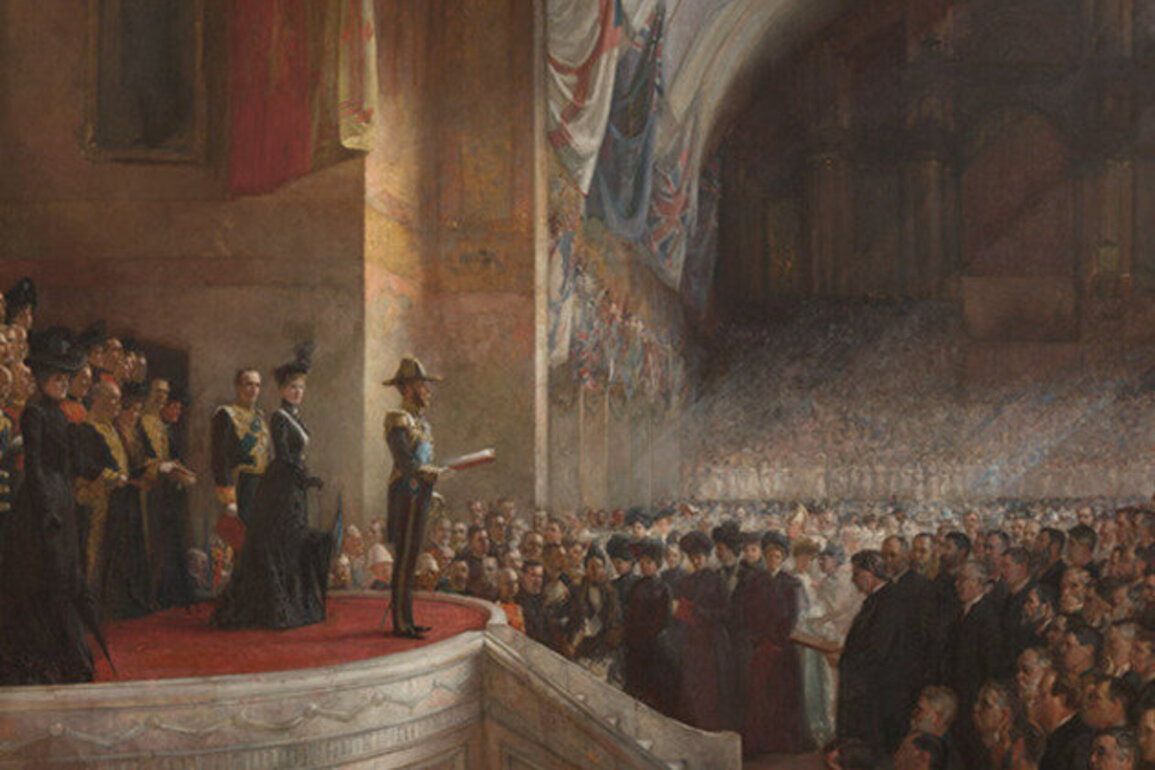
The opening of the new parliament was commemorated in oil on canvas by one of Australias best-known artists,Tom Roberts. Roberts paintingis titled The Opening of the First Parliament of the Commonwealth of Australia by His Royal Highness the Duke of Cornwall and York, 9 May 1901. It is widely known as theBig Picturein recognition of its grand scale. Measuring 5.65 metres across and 3.6 metres tall, it is painted on three separate pieces of canvas, stitched together.
Tom Roberts' "Big Picture" (Image via Wikimedia Commons)
Soon after its completion, the Big Picture was sent to England and presented toKing Edward VII. It remained there for many years, hanging inSt Jamess Palaceuntil 1957, when Queen Elizabeth II agreed to return the painting to Australia on permanent loan.
The painting was too large for its intended home at Old Parliament House in Canberra, and for many years it was in storage and only occasionally displayed. In 1981, after a major conservation project, it was hung in the new High Court of Australia building in Canberra.
When the new Parliament House was designed, a dedicated space for the painting was included in the foyer to theMain Committee Room, at the very heart of the building. This area includes architectural features such as a skylight and balustrade that were designed to echo Roberts original composition and connect the painting with other artworks from theHistoric Memorials Collection. The Big Picture has been on permanent public display in the new Parliament House since 1988.
Melbourne served as the temporary federal capital of Australia from 1901 until 9 May 1927, whenOld Parliament Housewas opened in Canberra.
Then, on 9 May 1988, the Federal Parliament transferred to the newParliament Houseon Capitol Hill, Canberra. InWalter Burley Griffin's plan for the city, this was the most prominent location in Australia's national capital. The new Parliament House is one of the largest buildings in the southern hemisphere.
The name of the new nation created on 1 January 1901 was the Commonwealth of Australia and continues in use 125 years later. The irony is that the Commonwealth of Australia was established as a constitutional monarchy with the British monarch as the Head of State. Yet the term Commonwealth has a strong republican ancestry.
It wasHenry Parkes, the Premier of New South Wales, who advocated the name Commonwealth of Australia at the1891 National Australasian Convention. This was the title accepted for the new nation by the delegates and, despite some controversy in the intervening years, it was the title agreed to, with little fuss, at thePeoples Convention in 1897 and 1898.
Henry Parkes proposal of the name Commonwealth of Australia was stated to be because of its old English meaning government for the common good and yet the popular republican meaning of Commonwealth and its associations toOliver Cromwells republic in Britain were equally known to the convention delegates when they adopted it.
Why Andrew is the monarchys biggest argument for an Australian republicFormer Prince Andrews scandals highlight a monarchy losing relevance and an Australia ready to move on.
On 9 May 1657, Oliver Cromwell formally refused the English crown when it was offered in theHumble Petition and Advice. Cromwell is still considered to be the father of parliamentary democracy. Australians today are used to the term Commonwealth, which runs parallel to republican traditions without bearing the explicit connotations or implying the essential institution of republicanism.
It is within the embrace of the term Commonwealththat its English political ancestry can be seen, the structure for any future Australian republic an Australian Head of State restrained within a parliamentary Westminster-style democracy rather than a U.S.-style executive president.
When Australians finally decide it is time for our independence, the obvious day of the year to inaugurate the Republic of Australia is 9 May, and the place to do it isJohn Dunmore Lang Place, a spacious grassed area below King Edward Terrace, Canberra and in a direct line with both Parliament Houses in Canberra.
John Dunmore Lang(17991878) was a turbulent Australian Presbyterian clergyman from Scotland, a writer, politician and activist, who was the first prominent advocate of an independent Australian nation and of Australian republicanism. In 1850,he founded the Australian Leagueto encourage national identity, resist convict transportation and promote a federal republic.
In 1850, Lang promoted his ideas inThe Coming Event; Or, the United Provinces of Australia, in which he predicted the formation of an independent Australian federal republic. By 1852, his republican activity culminated in the publication ofFreedom and Independence for the Golden Lands of Australiaan appeal for the establishment of a United States of Australia. This was the first argued case for an Australian republic and has become an established slogan of political radicalism and republicanism in Australia.
9 May 1657, 9 May 1901, 9 May 1927, 9 May 1988.
It is perhaps in the park named after Australias greatest republican advocate, on the shores ofLake Burley Griffin, Canberra, that on 9 May, our future Australian republic, the Commonwealth of Australia, will begin.
You can follow history editor DrGlenn Davieson Twitter/X@DrGlennDavies.
Related Articles
- Awed Albo abandons republic (and Australia's dignity) in haste to embrace King Charles
- Australias republican future faces a Trump-sized foreign threat
- Craig Foster succeeds Peter FitzSimons as Republic Movement head
- Royal glamour holding Australia back from becoming a republic
- ARM'S new model for republic not the people's choice